


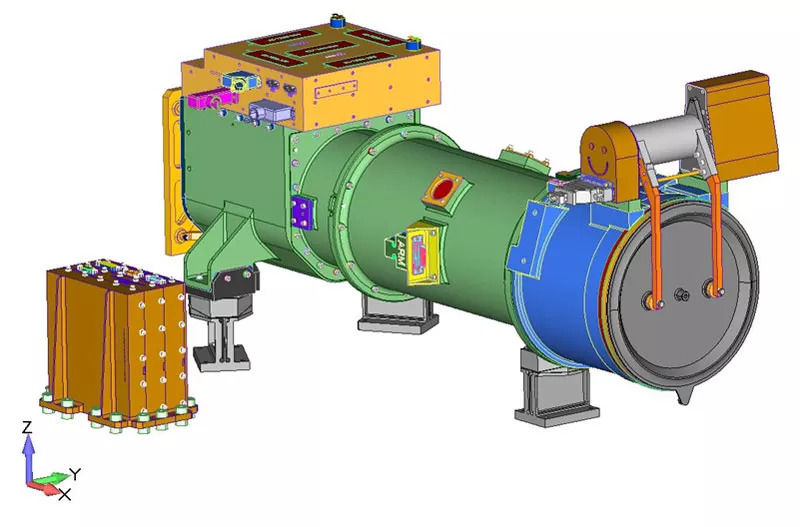
A digital rendering of the CCOR-1 instrument. Credit: U.S. Naval Research Laboratory
The GOES-U satellite will accommodate an additional space weather instrument, the Naval Research Laboratory’s Compact Coronagraph-1 (CCOR-1). CCOR-1 will reside on GOES-U’s Solar Pointing Platform, along with the Solar Ultraviolet Imager (SUVI) and Extreme Ultraviolet and X-ray Irradiance Sensors (EXIS). The Compact Coronagraph (CCOR) will image the solar corona (the outer layer of the sun’s atmosphere) and help detect and characterize coronal mass ejections (CMEs). CMEs are large expulsions of plasma and accompanying magnetic field from the corona. They can be remotely detected with white light imagery of the upper solar corona. CCOR is designed to capture white light imagery of the upper solar corona.
Sequences of CME images can be used to determine size, velocity, and density of CMEs. CME imagery is currently the only source of 1+ day watches of impending geomagnetic storm conditions. Geomagnetic storms are major disturbances of Earth’s magnetosphere caused by shock waves in the solar wind. Geomagnetic storms are the costliest type of space weather events as they can cause widespread damage to power grids, satellites, and communication and navigation systems. CMEs are the primary cause of geomagnetic storms.
| Attribute | Value |
|---|---|
| Mass: | 25 kg |
| Power: | 22.5 watts (operational) |
| Data rate: | 25 Kbps (average) |
| Envelope: | 90cm x 54cm x 39cm |
Currently, CME imagery at the Earth-sun line is provided by the Large Angle and Spectrometric Coronagraph (LASCO) instrument on board the European Space Agency (ESA)/NASA Solar and Heliospheric Observatory (SOHO) satellite, launched in 1995. As part of NOAA's Space Weather Follow-On Program, CCOR was developed at the Naval Research Laboratory to ensure continuity of critical CME imagery. The first CCOR instrument will fly on GOES-U, and subsequent CCORs will fly on other missions.
The CCOR-1:
- Is optimized for geostationary orbit and for GOES-U interfaces.
- Provides critical space weather measurements for the National Oceanic and Atmospheric Administration (NOAA) Space Weather Prediction Center (SWPC).
- Delivers imagery within 30 minutes of acquisition, compared to up to 8 hours from LASCO.
| Parameters | Requirements |
|---|---|
| Spectral Range | 480-730 nm broadband |
| Field of View | 3.7-17 Solar Radii |
| Minimum Intensity | 1x10^-11 Bsun |
| Maximum Intensity | 1x10^-8 Bsun |
| Spatial Resolution | <50 arcsec |
| Maximum Acquisition Time | 30 seconds |
| Refresh Rate | 15 minutes |
CCOR will capture at least two images of each CME and will be capable of operating during intense solar storms and flares. The addition of CCOR to GOES-U will enhance NOAA’s space weather observational capabilities and improve forecasts.
CCOR’s primary data product is coronal white light intensity from which NOAA’s Space Weather Prediction Center (SWPC) can perform CME characterization.
Compact Coronagraph Image Gallery
Related News
-
Feature Story
Artemis II is planned as a 10-day crewed mission around the moon that marks humanity’s return to… -
Announcement
On January 23, 2026, NOAA’s Space Weather Follow On – Lagrange 1 (SWFO-L1) observatory executed its… -
Satellite Snapshots
Did you see the auroras? Our satellites certainly had an eyeful as they watched a powerful coronal… -
Announcement
The Solar Wind Plasma Sensor (SWiPS) onboard the Space Weather Follow On – Lagrange 1 (SWFO-L1)…


