


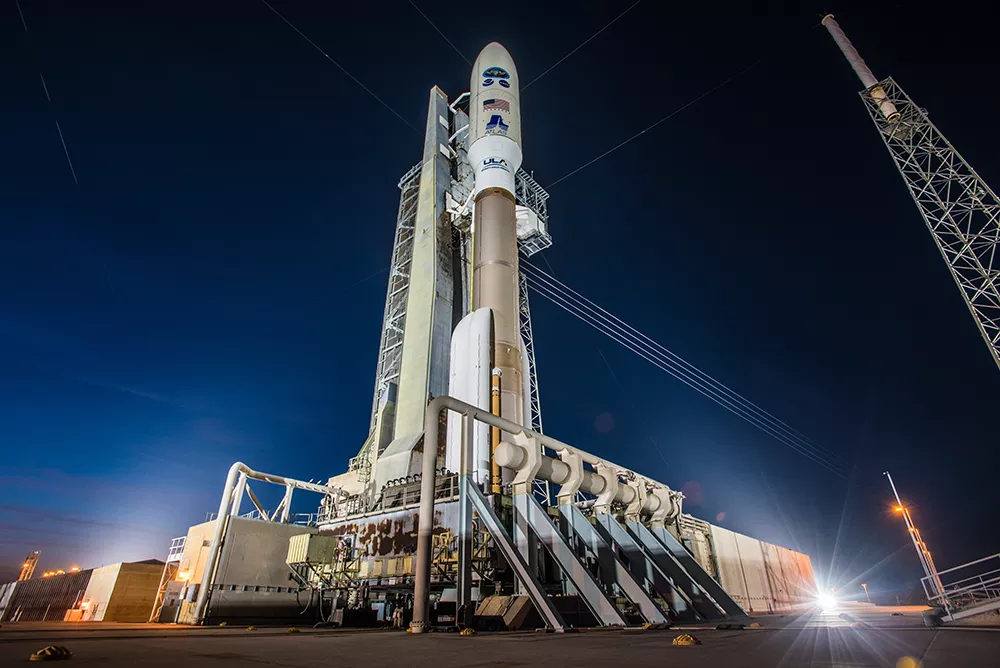
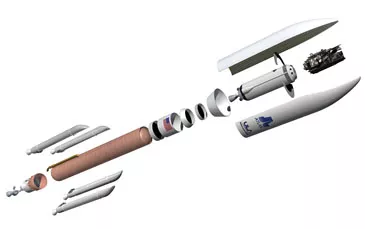
The GOES-R, GOES-S, and GOES-T launch vehicle is an Atlas V 541 expendable launch vehicle (ELV). The term expendable launch vehicle means each vehicle is only used once. The three numbers in the 541 designation signify a payload fairing, or nose cone, that is approximately 5 meters (16.4 feet) in diameter; four solid-rocket boosters fastened alongside the central common core booster; and a one-engine Centaur upper stage.
A launch vehicle is chosen based on how much mass the vehicle can lift into space. A two-stage Atlas V 541 launch vehicle was selected for the GOES-R, S and T launches because it has the right liftoff capability for the heavy weight requirements. GOES-U launched aboard a SpaceX Falcon Heavy rocket.
Atlas V
The GOES-R satellites weigh 6,173 pounds, or 2,800 kilograms at launch. The launch vehicle is 191 feet tall and will weigh 1.17 million pounds.
Stage 1: Atlas V Rocket: Fuel and oxygen tanks that feed an engine for the ascent; powers spacecraft into Earth orbit.
Solid Rocket Motors: Used to increase engine thrust; four total.
Stage 2: Centaur: Fuel and oxidizer and the vehicle's "brains"; fires twice, once to insert the vehicle-spacecraft stack into low Earth orbit.
Payload Fairing: Thin composite or nose cone to protect the spacecraft during the ascent through Earth's atmosphere.

Falcon Heavy
The Falcon Heavy rocket is composed of three reusable Falcon 9 nine-engine cores whose 27 Merlin engines together generate more than five million pounds of thrust at liftoff, equal to approximately eighteen 747 aircraft.
- Height: 229.6 feet (70 meters)
- Mass: 3,125,735 pounds (1,420,788 kilograms)
Fairing: Protects satellites during delivery to LEO, GTO and beyond
Interstage: Composite Connects first, second stages, All-pneumatic separation
First Stage: Liquid oxygen and kerosene propellants, High strength aluminum-lithium alloy
Merlin Engines: Engine-out reliability, 5,130,000 lbf of thrust at sea level, 5,548,500 lbf of thrust in vacuum
Second Stage: In-space start capacity, Powered by one MVac engine
Grid Fins: Aids precision landing
Landing Legs: For landing rocket safely back on Earth after takeoff